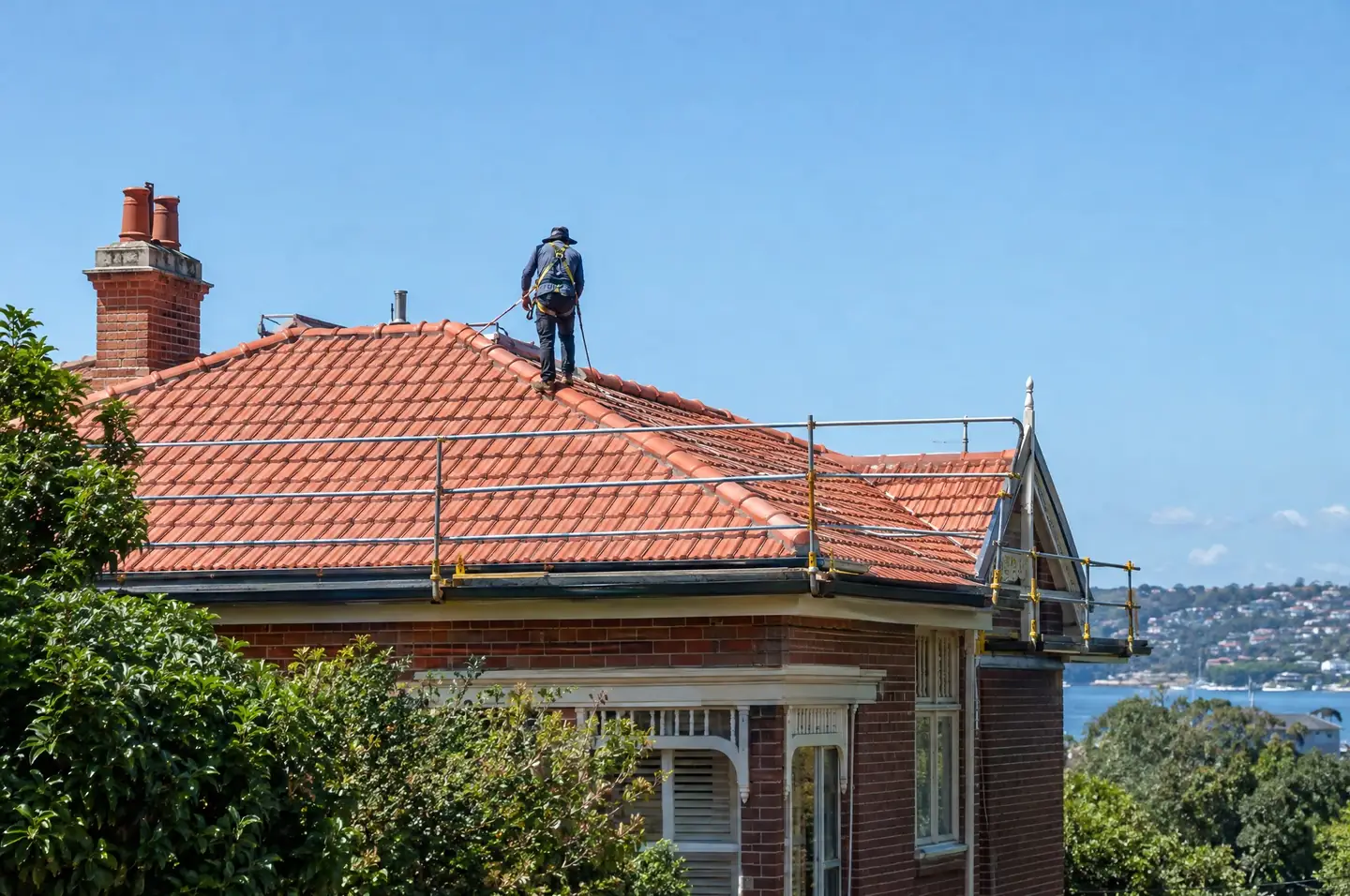
About roof cleaning
Roof cleaning removes lichen, moss, mould and grime from tiled and metal roofs. On terracotta and concrete tiles the usual method is a treatment that kills the growth followed by a controlled low-pressure rinse, or a straight pressure clean on sound concrete tiles before a restoration. On Colorbond and other steel roofs it is a soft wash, since high pressure lifts the paint film. It is worth doing when growth is thick enough to hold water against the tiles, when gutters keep filling with moss, before solar panels go on, before painting or repointing, and when the roof is the first thing buyers will see.
Our three regions are hard on roofs. Salt air from Palm Beach down to Coogee corrodes screws, flashings and the sheltered metal rain never rinses. The tall gums over Turramurra, Wahroonga, St Ives and Terrey Hills shade roofs and drop litter that feeds moss, and the figs of Mosman and Bellevue Hill do the same. Federation and interwar terracotta in Lindfield, Killara and Randwick is often brittle, and a careless boot breaks tiles. Slate in Paddington and Woollahra needs a specialist. Many of these houses are in heritage conservation areas, where the roof is part of the streetscape and a gentle method matters.
Cleaning a roof is not licensed work, but it is work at height, and NSW safety regulations expect fall protection wherever a drop could cause injury: edge rails, harnesses on rated anchors, or an elevated work platform. If cleaning turns into repointing ridges, replacing tiles or recoating, that counts as residential building work, and above 5,000 dollars including GST the tradie must hold a licence in the right class. Two more rules sit over every job. Super six and other asbestos cement roofing is never pressure cleaned, and the dirty run-off must not reach the stormwater system, which means downpipes are diverted or capped and tanks disconnected first.

What the job usually includes
How it works
- Tell us about the roofSay whether it is terracotta, concrete tile, slate or metal, how many storeys, and roughly how old the house is. A photo from the street and one from the backyard shows the pitch and the growth. Mention solar panels, skylights, a rainwater tank, and where a ladder or lift could go. If you suspect asbestos, say so.
- We match vetted roof cleaning tradiesThe job goes to vetted, independent tradies who clean roofs in your area and own the access gear for it: harnesses, anchors, edge rails or a lift. Before they joined we matched their ID to an active ABN, checked their public liability certificate and looked at recent roofs they have done nearby. Matching costs you nothing.
- A written quote under their own nameEach tradie quotes you directly after seeing the roof. The quote should describe the method for your roof type, how they will get onto it safely, what happens to the run-off, whether gutters are cleared afterwards, and what is excluded, such as broken tiles or repointing, which would be quoted separately if you want them.
- The cleanThe tradie sets up fall protection, isolates the tank and diverts downpipes, then treats the growth. Tiles are rinsed from the ridge down with the pressure and fan angle kept well away from the overlaps so water is not driven under them. Metal is washed softly. Fragile sections are walked only on the tile noses or avoided with a pole. Solar panels are not touched unless that is part of the job.
- After the jobAsk for before and after photos, since you will not be climbing up to check. Look at the gutters, the ground under the eaves and any paths the run-off crossed. Reconnect the tank once the first good rain has flushed the roof. Let us know how the tradie went, which is how the network is kept honest.
Gentle on the roof, serious about the edge
The roof decides the method. Terracotta has a fired surface that cleans well but cracks underfoot, so a good tradie walks the bottom edge of each tile near the battens and uses a pole for the rest. Concrete tiles lose a little surface with every aggressive clean, which is why treatment and a gentle rinse beat raw pressure unless a restoration coat is going on next. Steel roofs are soft washed only. Moss and lichen are killed first and allowed to die back, rather than being blasted off with their root pads still holding the surface. Ridge capping, valleys and flashings are rinsed carefully because that is where old mortar and sealant fail.
Safety and water handling tell you who you are dealing with. A professional arrives with a harness and rated anchors, or temporary edge rails, or an elevated platform, and will not quote a two-storey roof from a ladder. They cap the tank, divert downpipes onto lawn or into a capture, and keep the run-off, with its chemicals and lichen, out of the street gutter. They refuse to pressure clean fibro or super six, and they stop to tell you about cracked tiles and rusted valley irons instead of hiding them under a nice-looking result. All of that belongs in the written quote, and so does the clean-up of the mess that lands in the gutters and garden.
Questions worth asking the tradie
Frequently asked questions
It can. Terracotta tolerates a careful rinse but breaks under careless feet, and concrete tiles shed surface under high pressure, especially older ones. Water driven up under the overlaps can also end up in the ceiling. A measured treatment followed by a controlled rinse is kinder, and the lance is kept pointing down the slope.
Steel roofs should be soft washed, not blasted. High pressure can lift the paint film and drive water into laps and screw holes. A gentle detergent wash and a fresh-water rinse is the approach the steel makers favour, and it also deals with the salt that builds up on sheltered sections near the coast that rain never reaches.
No. Cleaning removes growth and grime. Restoration adds repointing of ridge caps, replacing broken tiles and applying a sealer or coloured coating, which is residential building work and needs a licensed tradie when the job runs past 5,000 dollars including GST. Cleaning is the first step of a restoration, but it stands on its own.
The tradie disconnects or bypasses the tank before any treatment goes on, so chemicals and lichen do not end up in your water. After the clean the first flush of rain should be diverted too. Ask how they will do this and when it is safe to reconnect.
Asbestos cement roofing, often called super six, must not be pressure cleaned, sanded or scrubbed, because that releases fibres over your home and the neighbours'. SafeWork NSW has warned contractors about exactly this. If a tradie suspects asbestos they should stop and talk to you about sealing or removal by a licensed removalist instead.
It depends on shade and salt. A roof in full sun on an open block may go many years. Under gums or figs, or on a shaded southern slope near the water, moss and lichen return faster. A good guide is to act when growth is visible from the ground or gutters keep filling, rather than on a fixed schedule.