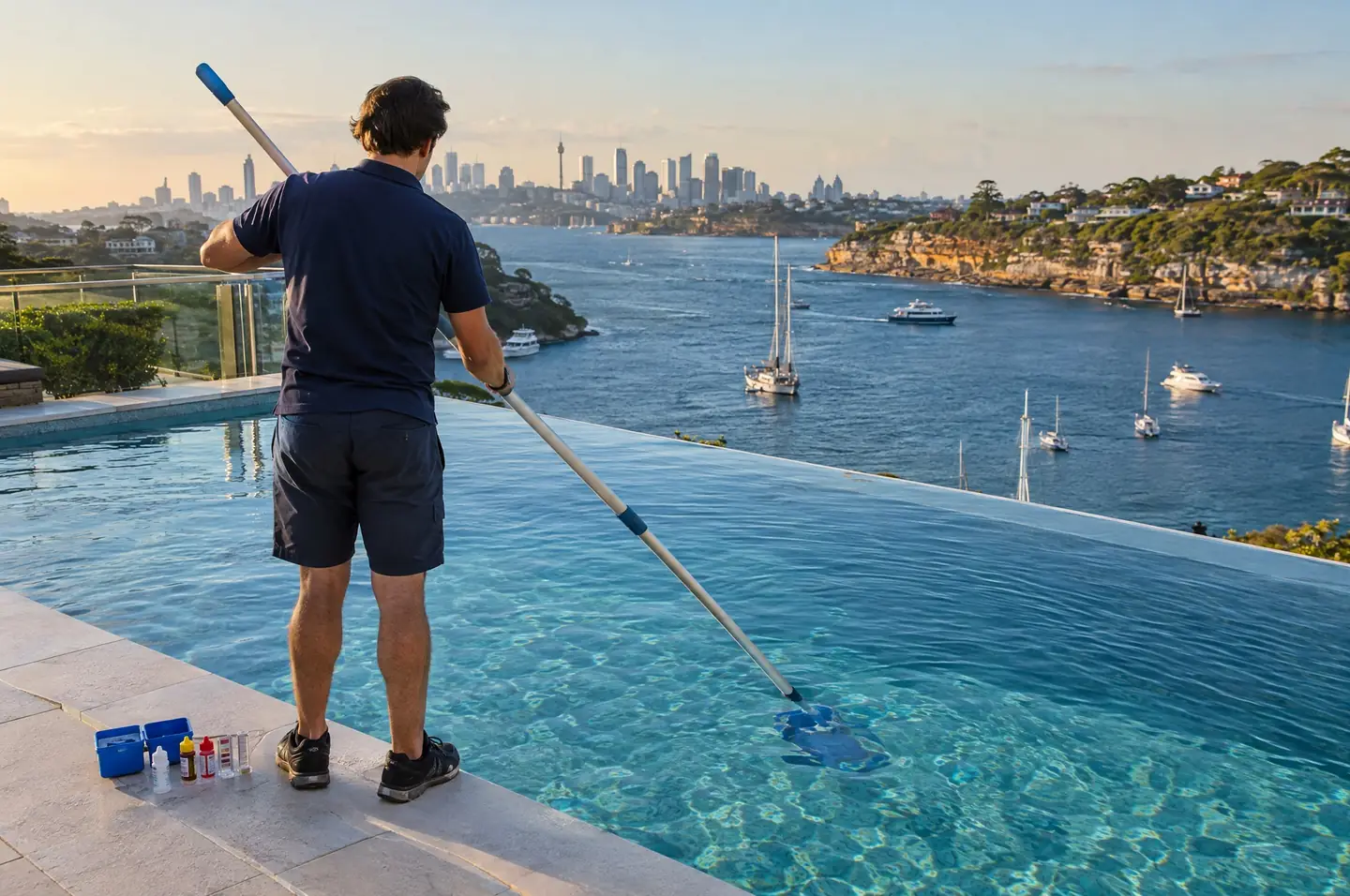
About green pool recovery
Green pool recovery is the staged treatment that turns an algae-filled pool back into clear, balanced water: testing, clearing debris, brushing, correcting pH, shock chlorinating, adding algaecide or clarifier, vacuuming dead algae to waste, cleaning the filter repeatedly and rebalancing. Severe or black-spot cases may need the pool drained and acid washed, which is a specialist job in itself. Recovery is worth doing properly the first time, because half-treated pools go green again in a week. It is the usual call after a holiday, a storm, a failed chlorinator or pump, or a changeover at a rental or a sale.
Local pools go green for local reasons. Weekenders in Palm Beach, Avalon and Whale Beach sit unattended for weeks over a hot stretch; one dead salt cell in January is enough. Shaded pools under the gums of Pymble and Wahroonga start early each spring. Summer storms wash leaf litter, soil and phosphates into pools from Coogee to Collaroy and dilute the chlorine in an afternoon. Rentals in Randwick and Manly turn green between tenants. A stagnant pool also breeds mosquitoes, and councils can require an owner to deal with a pool that has become a health hazard, so a green pool is not just an eyesore.
Acid washing and pool cleaning sit within the NSW swimming pool repairs and servicing licence class, so a licence is needed when a recovery job, often with equipment repairs, exceeds the Home Building Act threshold; any wiring goes to a licensed electrician regardless. We check the licence where it applies and the ABN, insurance and references in every case. The environmental rule is the one most often broken: water vacuumed to waste or drained from a pool is chlorinated and full of algaecide, and it must go to the sewer, not the stormwater system. NSW environment protection law makes that an offence; Sydney Water sets how pool water enters its sewer.
What the job usually includes
How it works
- Tell us about the poolSay how green it is (cloudy, green or black), roughly how long it has been that way, what you think caused it, and whether the pump and chlorinator are running. Photos of the water and the equipment pad help. Note whether there is a deadline such as a tenant, a party or an open home.
- We match local pool techniciansYour job goes to vetted, independent pool technicians who do recoveries in your suburb and hold any licence the work needs. Each has passed identity, ABN, insurance, work-history and conduct checks.
- They quote you in writingInterested technicians contact you, usually after testing the water on site, and quote in writing under their own name. The quote should set out the staged plan, the expected number of visits, chemicals, whether a drain and acid wash is likely, and how waste water will be discharged. You choose, with no obligation.
- The recoveryA careful technician fixes the cause first, so the pump runs and the chlorinator or dosing works, then balances pH before shocking because chlorine is weak at high pH. They brush every surface, run the filter continuously, clean it as it clogs, vacuum dead algae to waste through the sewer connection and never to the street, and return to retest until the water holds chlorine on its own.
- Once it is clearAsk for the final readings and what to do for the next fortnight: run times, chlorine checks and when to swim. Consider a regular service so it does not happen again. Then tell us how the match went; feedback after every job keeps the network honest.
Fix the cause, then treat the water in the right order
A green pool is a symptom. Good technicians find out why the chlorine disappeared before they add more: a pump that stopped, a cell that died, a filter that is bypassing, stabiliser so high that chlorine is locked up, or simply weeks without circulation. Then they work in order: debris out, pH down into range, a heavy chlorine shock sized to the pool, algaecide if needed, continuous filtration, brushing twice a day in the early stages, and clarifier or flocculant to drop the dead algae so it can be vacuumed to waste. They return and retest rather than declaring victory when the water first looks blue.
The shortcuts are what to watch for. Draining a concrete pool in wet ground without checking groundwater can float or crack the shell, and draining a fibreglass pool can pop it, so draining is a last resort done with knowledge of the site. Vacuumed or drained water goes to the sewer through the property's connection, never across the lawn into the gutter. Chlorine and acid are never stored or added together. A technician who promises a clear pool in a day with a single bottle of something is selling you the next green pool. And if the barrier or gate is not compliant, they should tell you, because an unusable pool still has to be fenced.
Questions worth asking the tradie
Frequently asked questions
A lightly green pool with working equipment often clears in a few days of shocking, filtering and vacuuming. A dark green or black pool, or one with a failed filter or chlorinator, can take a week or two and several visits, and in the worst cases a drain and acid wash. The quote should describe the stages rather than promise a date.
Chlorine ran out and algae took over. The usual reasons are a pump or chlorinator that stopped, a filter that is dirty or bypassing, very high stabiliser locking up the chlorine, heavy rain diluting the water and washing in nutrients, weeks of heat without a check, or a timer set too short. Fixing that cause is step one; otherwise the pool goes green again.
Usually not. Most green pools recover with chemical treatment, continuous filtration and vacuuming to waste. Draining is reserved for black algae, heavy staining or water so loaded with stabiliser or dissolved solids that treatment will not work, and it carries risks: concrete shells can lift in wet ground and fibreglass shells can pop. A technician who knows the site will advise, and the water must go to the sewer.
Wait until the technician confirms that chlorine has settled back into the normal range, pH is balanced and the water is clear enough to see the floor drain. After a heavy shock the chlorine can be far above swimming levels for a day or more. NSW Health's public pool guidelines, for comparison, do not allow swimming until total chlorine has dropped below 10 milligrams per litre after shock dosing.
Yes, with circulation and chlorination that keep running while nobody is there: a reliable timer and chlorinator, a longer pump run in hot weather, a cover to keep leaves out, and a fortnightly check by a regular technician or a holiday home maintenance tradie. Ask the technician to check the equipment before the summer stretch and to leave a note of the settings.
A staged plan: testing and diagnosis, debris removal and brushing, chemicals for pH correction, shock and algaecide, vacuuming to waste, repeated filter cleaning, rebalancing, and the visits expected. Equipment repairs and a drain and acid wash are normally quoted separately once the technician knows they are needed. Ask what happens if the pool needs more visits than planned.