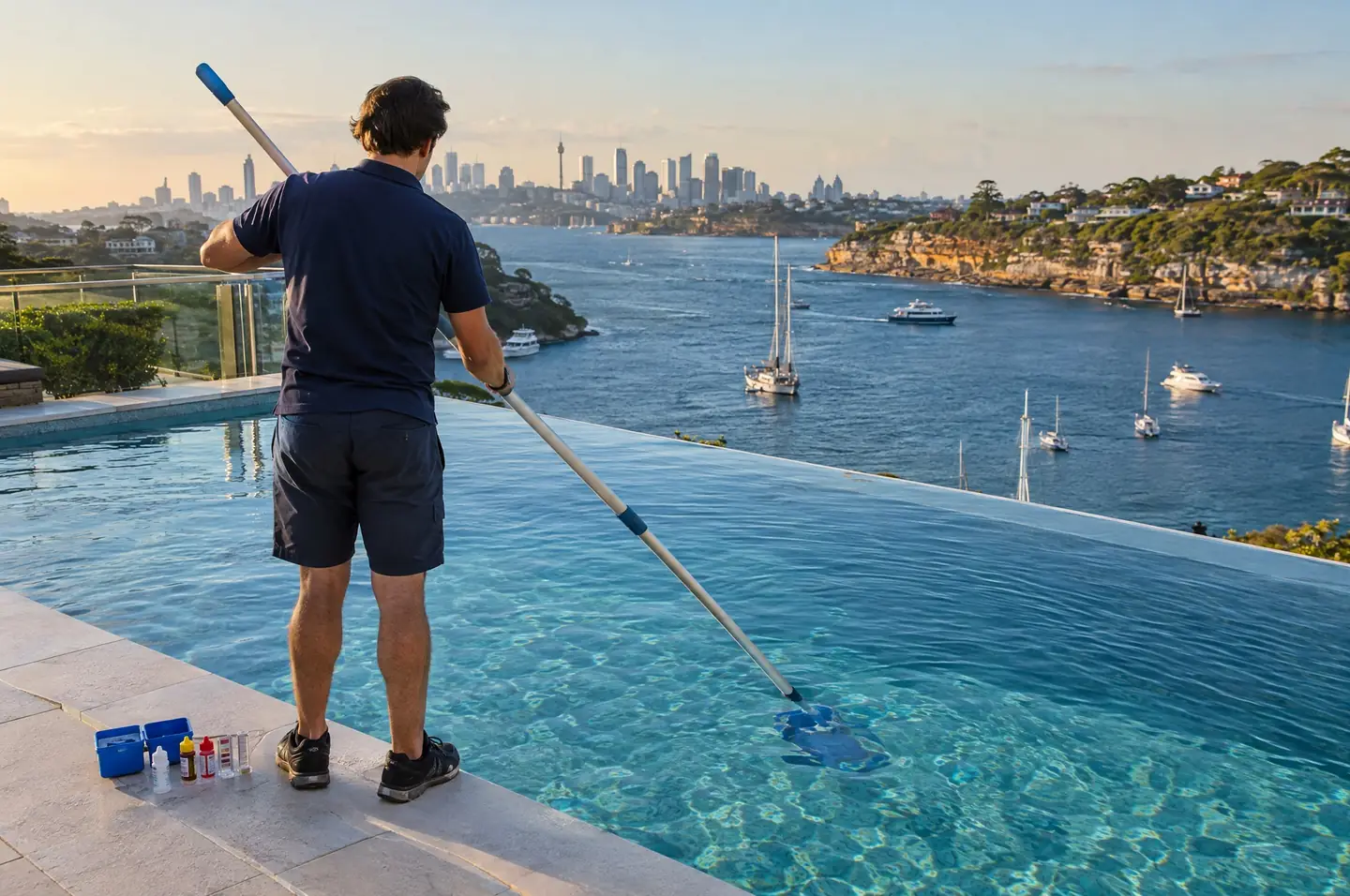
About pool cleaning
Pool cleaning is the routine service that keeps a pool safe to swim in and the equipment alive: skimming, brushing walls and steps, vacuuming, emptying skimmer and pump baskets, cleaning or backwashing the filter, testing the water and adjusting pH, chlorine, alkalinity, calcium hardness, stabiliser and salt. Most pools in Sydney want a visit every week or fortnight through summer and monthly through winter. A regular service is worth it when the pool is used often, when it sits under trees, when the house is a rental or a weekender, or when you have already lost a summer to cloudy water.
Local pools work hard. Ocean wind drives salt and sand into pools from Bondi to Palm Beach and strips chlorine on hot afternoons, while jacarandas, gums and Norfolk pines fill skimmers in Mosman, Lindfield and Avalon every autumn and spring. Wet-edge and infinity pools on the harbour slopes of Vaucluse, Point Piper and Cremorne carry balance tanks and second pumps that need checking, and heavily shaded North Shore pools fight algae from October on. Summer storms dump leaf and dirt and dilute the chemistry in an afternoon. Pools at holiday homes on the peninsula sit unattended for weeks, which is how green pools start.
Pool cleaning sits in the NSW licence class for swimming pool repairs and servicing, but a licence is only needed once a job's value passes the Home Building Act threshold, which a cleaning visit never reaches, so the vetting checks carry the weight: ABN and identity, public liability insurance, references and local photos. Two rules apply every visit. Backwash and vacuum-to-waste water must go to the sewer, never the stormwater drain; the Protection of the Environment Operations Act makes it an offence, and Sydney Water sets the sewer rules. And the barrier must comply with the Swimming Pools Act 1992; a technician cannot certify it, but should mention a gate that no longer self-closes.
What the job usually includes
How it works
- Tell us about the poolGive the pool type (concrete, fibreglass or vinyl), its rough size, whether it is salt or chlorine, the filter type if you know it, and what you want: a regular service, a pre-summer clean or a fix for cloudy water. Photos of the pool and the equipment pad help, and so does noting gate codes, dogs and parking.
- We match local pool techniciansYour job goes to vetted, independent pool technicians who service pools in your suburb and have passed identity, ABN, insurance, work-history and conduct checks.
- They quote you directlyInterested technicians contact you and quote in writing under their own business name. For a regular service the quote should say the frequency, what each visit covers, whether chemicals are included or charged as used, and how equipment faults will be reported. You choose, with no obligation.
- The service visitA careful technician tests before touching anything, brushes before vacuuming, cleans the baskets and filter, checks pressure, flow and the chlorinator cell, and balances the water in the right order rather than dumping chlorine. Backwash water goes to the sewer connection. Chemicals are kept apart from each other, out of the sun and away from children, and the gate is checked on the way out.
- After each visitRead the visit note, look at the water the next morning, and ask about anything flagged, such as a cell nearing the end of its life or a gate that sticks. Tell us how the technician went; feedback after each match keeps the network honest.
Balanced water, not just chlorine
Anyone can tip chlorine in a pool. A good technician tests properly with fresh reagents or a photometer, and balances pH and alkalinity first, because chlorine works far less well when the pH is high, then sets stabiliser so the sun does not burn the chlorine off by lunchtime, and keeps calcium hardness in range so the water neither etches the plaster nor scales the salt cell. They brush the walls every visit, because algae starts where the circulation is poor, and they vacuum to waste rather than through the filter when the floor is dirty. They read the pump basket and filter pressure as a diagnosis, not a chore.
The habits around the pool matter too. Backwash goes to the sewer, never onto the lawn next to a stormwater pit or down the driveway, and a technician who does otherwise is breaking the law on your property. Chemicals are stored separately and never mixed, with chlorine and acid kept well apart. The salt cell is inspected and cleaned when scaled rather than left to fail. The technician notes a gate that does not self-latch, a loose coping stone or a cracked skimmer lid, because small things become compliance and safety problems. And they leave a visit record, so you can see trends rather than guess.
Questions worth asking the tradie
Frequently asked questions
Weekly or fortnightly from October to April, when heat, swimmers and storms work against the chemistry, and monthly through winter if the pool is covered or little used. Pools under trees, salt-blasted beachfront pools and pools at weekenders usually sit at the frequent end. A technician will suggest a schedule after seeing the pool and the equipment.
For a chlorinated outdoor pool, a pH between about 7.2 and 7.6, free chlorine around 1 to 3 milligrams per litre, higher if stabiliser is used, total alkalinity around 80 to 120, calcium hardness in the range the pool surface needs and stabiliser kept moderate, since very high levels make chlorine sluggish. NSW Health's public pool guidelines set similar ranges, with pH from 7.0 to 7.8 and a stabiliser cap of 50 milligrams per litre. Salt pools need the salt level the chlorinator specifies.
A salt pool makes its own chlorine from salt in the water, so the technician checks the salt level, the cell for scale and the output setting, and still balances pH, alkalinity and stabiliser because a chlorinator pushes pH up. A manually chlorinated pool needs chlorine dosed each visit. Both need the same brushing, vacuuming and filter care.
Rain dilutes the chemistry and washes dirt, leaves and phosphates into the pool, and the next hot day can turn it cloudy or green. A post-storm visit to clear debris, clean the baskets and filter and rebalance the water saves a full recovery later, and many regular technicians will fit one in. Keep the pump running longer for a few days afterwards.
Many can diagnose and service equipment, and the quote should say so. Replacing a pump or filter, rebuilding pipework or fitting a chlorinator is a separate job, licensed in NSW when the value exceeds the Home Building Act threshold, and any hard wiring must be done by a licensed electrician. Post it as pool equipment servicing so the right tradies respond.
Yes. Backwash and drained pool water carry chlorine, salt and filter debris, and letting them reach the stormwater system, which runs straight to the harbour or the ocean, counts as pollution of waters under NSW law and attracts penalties. Sydney Water's rules direct pool water to the sewer through the property's sewer connection. A technician should know where yours is.