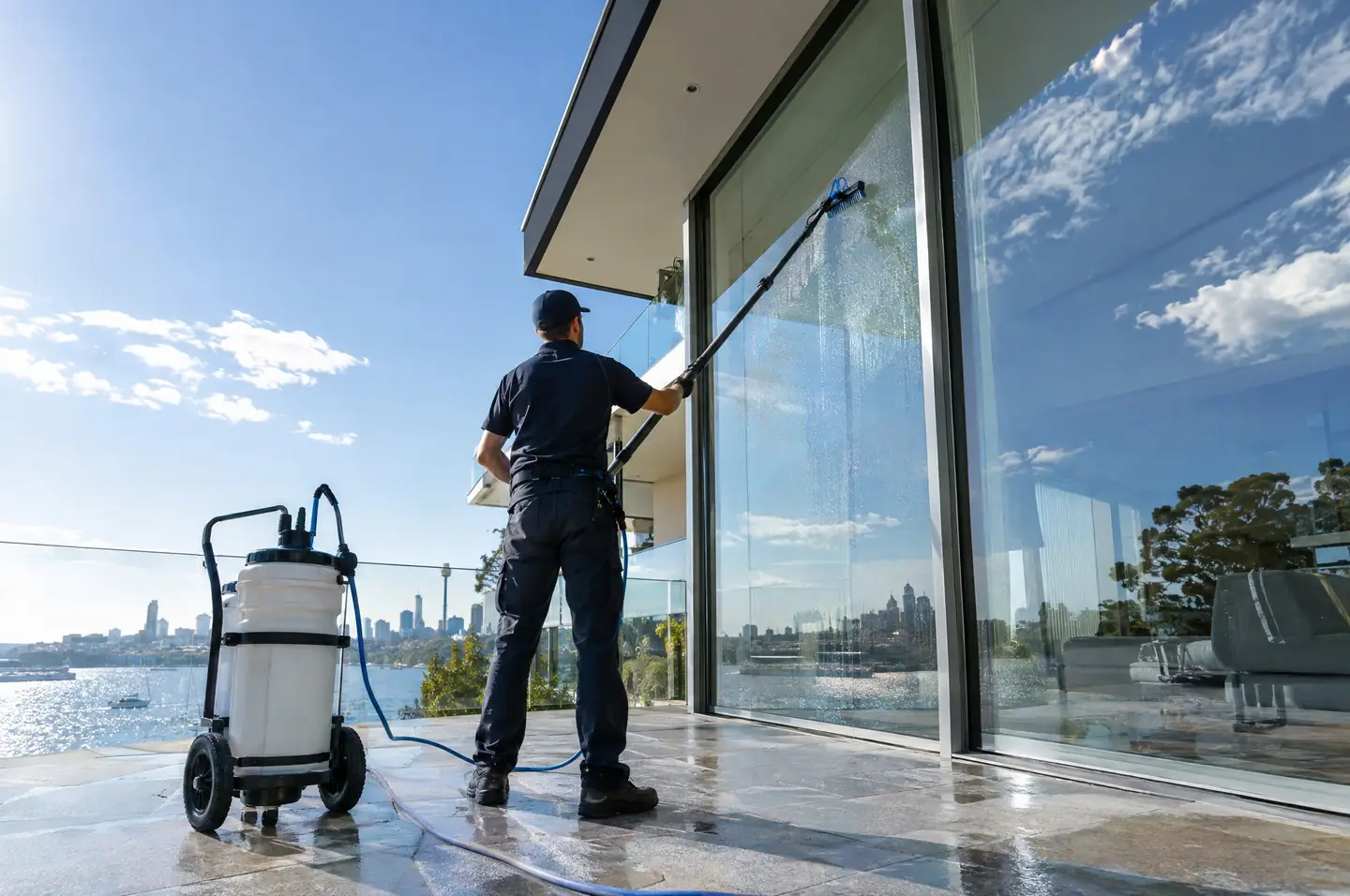
About high & hard-to-reach window cleaning
High window cleaning is for the glass a normal visit cannot reach: upper floors on steep blocks, stairwell and void windows, skylights, roof lanterns, glass atriums, highlight windows above a double-height living room, and the outside of apartment glass. The tools change with the height. Standing on the ground with a purified-water pole, a tradie can cover three or four storeys. Beyond that, or where there is no ground to stand on, the tradie brings an elevated work platform, a scaffold tower, rope access or interior platforms for voids. It is worth booking when the main windows are being done anyway, so the whole house finishes at once.
These suburbs are made for difficult glass. Houses step down steep slopes in Clontarf, Seaforth, Castlecrag, Northbridge and Dover Heights, so a window that is one storey from the street is three from the garden. Modern builds in Mosman, Bellevue Hill and Whale Beach run double-height glazing toward the view. Renovated terraces in Paddington add roof lights over stairwells, and Federation homes in Killara and Wahroonga have gable windows above steep tiled roofs. Apartment buildings from Kirribilli to Coogee need the outside done as a building, through the owners corporation, usually by rope access or a lift from the street.
No licence is needed to clean a window at any height, but working at height is regulated. NSW work health and safety rules require fall controls where a fall could injure, with the preferred order being work from the ground, then platforms or rails that prevent a fall, then harness systems, and ladders only for short, low tasks. Operating a boom lift with a boom of eleven metres or more requires a high risk work licence. Our vetting checks identity against an active ABN, holds the public liability certificate, which should cover work at height, and looks at recent local jobs and references. On common property, strata approval comes first.
What the job usually includes
How it works
- Tell us where the glass isDescribe the hard parts: how many storeys at the lowest side of the block, skylights and their roof pitch, void windows and the floor height below them, and whether there is flat ground, a driveway or a neighbour's side passage to work from. Photos from the garden and the street tell the tradie most of what they need.
- We match tradies equipped for heightsWe send the job to vetted, independent window tradies who already handle high glass in your area with long poles, platforms or rope access. Each has shown us ID matched to an active ABN, a public liability certificate that covers work at height, and photos of similar jobs nearby. The match is free and the decision is yours.
- A written quote with the access planThe tradie usually visits before quoting, because the price depends on how the glass is reached. The quote under their own name should describe the access method for each difficult window, the fall protection, any lift hire, how long the driveway or street will be used, and what cannot be done safely.
- The workOn the day the tradie sets up fall protection first: anchors and harnesses, a platform or rails, or a lift positioned on firm ground with outriggers down. Exclusion zones keep people and cars from underneath. Glass is cleaned with purified water from the pole or by hand from the platform, frames and sills included. Skylights are cleaned without standing on the glass.
- After the jobLook at the high glass from inside in afternoon light, and at any void glass from the stairs. Ask about seals, cracks or leaks the tradie saw up close, since nobody else will get that view. If part of the work was deferred for safety, agree how it will be done. Then tell us how it went.
Access first, then the glass
Good high-window work starts with a plan for getting there without anyone falling. From the ground, a carbon pole with purified water handles most upper-floor glass on a house and leaves no spots, and it is always the first choice because nobody leaves the ground. Where the pole cannot reach or the angle is wrong, a professional moves up the hierarchy that safety regulators describe: a platform or edge rails that stop a fall, a harness on rated anchors where those are not practical, and a ladder only for brief, low work with someone footing it. Interior voids get a platform or scaffold tower on protected floors, never a ladder balanced on the stairs.
The glass itself needs the same care as any other, with some extra. Skylights and roof lanterns are cleaned from a position beside them, not on them, because acrylic and glass roofs are not made to take a person's weight. Frames are scrubbed before the pane. Seals, flashings and cracked panes are reported because the tradie is the only one who sees them. Rope access crews work in pairs with rescue plans, and lifts are set up on outriggers with the ground checked. On strata buildings all of this runs through the owners corporation, with notice to residents and the building's own anchor certification checked before anyone clips on.
Questions worth asking the tradie
Frequently asked questions
In everyday use, three or four storeys from level ground. Beyond that the pole becomes hard to control and the tradie cannot see the glass well enough to finish it properly. On steep blocks the useful reach depends on where they can stand, which is why a site visit before quoting is normal for difficult houses.
The inside face can, with a pole or a platform. The outside needs roof access or a position beside the skylight with fall protection, because standing on the skylight itself is dangerous and a common cause of falls. Fixed roof lights on steep tiled roofs sometimes need anchors or an edge rail to reach safely.
The outside of the building, including windows, is common property in most strata schemes, so the owners corporation engages a company for the whole facade, usually by rope access or lift. Owners book the inside themselves. Any work on the exterior needs approval through the strata manager, and the building's anchor points need current certification.
Cleaning windows is not licensed at any height. Some of the access equipment is: operating a boom-type elevated work platform whose boom is eleven metres or longer needs a high risk work licence in NSW, and scaffolds where someone could fall more than four metres must be erected by a licensed scaffolder. Ask what equipment is coming and who will operate it.
Rope access is a recognised method with trained technicians working in pairs on two independent ropes with a rescue plan. For a house it is rarely needed; for apartment towers it is often the least disruptive option. Ask for the technician's training certification and confirm the building's anchors have been inspected recently.
Yes, and it is usually the sensible way to do it, since the access set-up takes the most time. Many homeowners pair the high glass with every second or third standard clean. Agree what is in the regular visit and what is in the occasional one, so there are no surprises when the lift turns up.