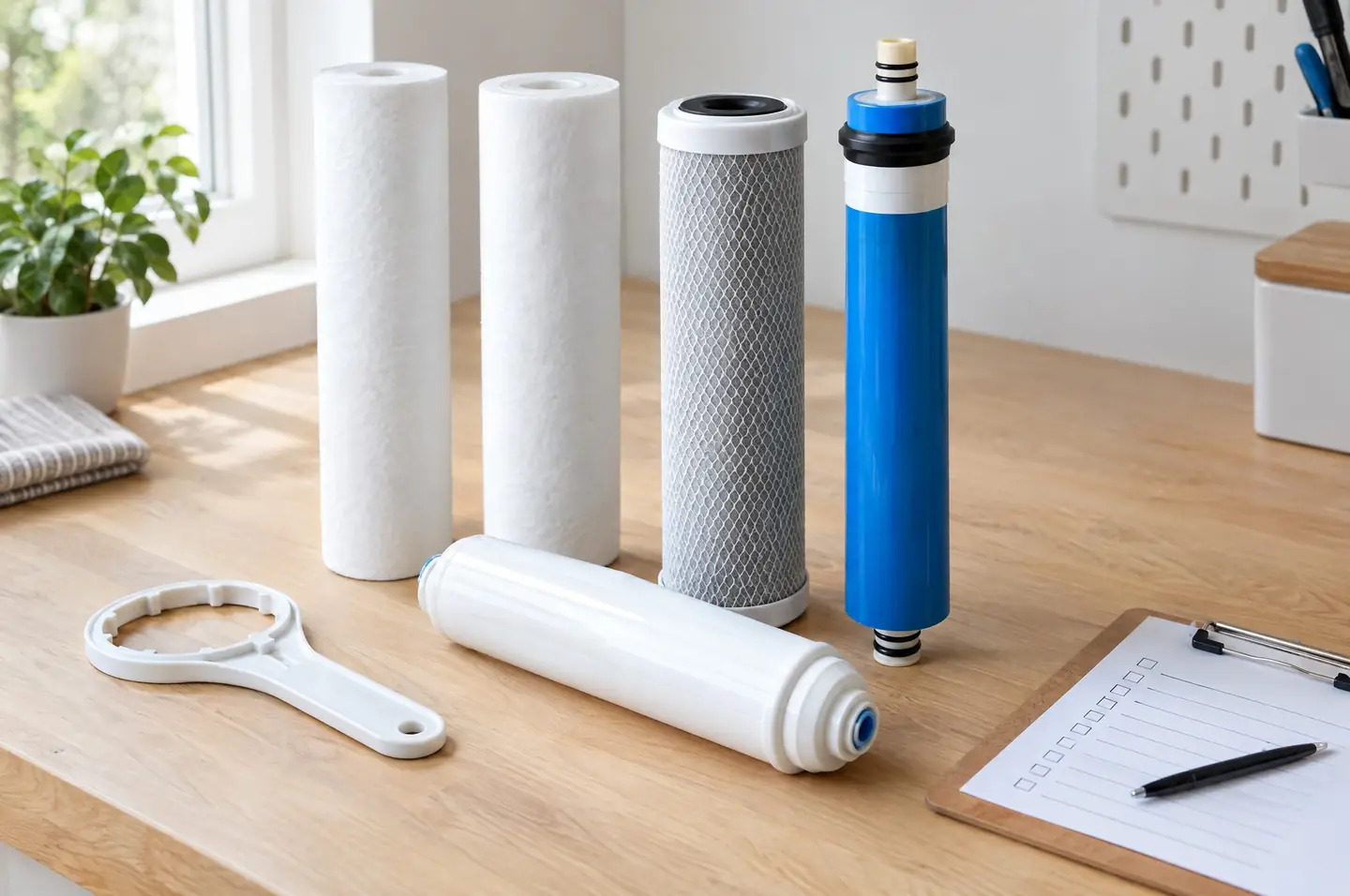
About filter replacement & servicing
Every filter system runs on a schedule set by its manufacturer and your water use. Manufacturer guides commonly give six to twelve months for sediment and carbon cartridges. One Australian under-sink RO guide specifies pre- and post-filters at six months or 8,000 litres and the membrane at eighteen to twenty-four months. UV lamps are generally replaced yearly, boiling-tap filters about annually in an average home, and plumbed fridge filters around six months. A service visit replaces what is due, cleans the housings, checks O-rings, flushes new media and leaves a written record of what was fitted and when the next change falls.
Local life affects the interval. Holiday houses at Palm Beach, Whale Beach and up at Avalon sit empty for weeks, so cartridges should be flushed on return and standing water run off. Properties in Terrey Hills and Duffys Forest often run rainwater through sediment stages and UV, which need lamp and sleeve care as well as cartridges, and a check that the low-UV alarm works. Older pipework in Hunters Hill and Wahroonga sends extra sediment after mains work in the street, shortening the life of the first stage. Clear outdoor housings in full sun on north-facing walls grow algae and should be shaded or swapped for opaque ones.
Swapping a cartridge inside an existing housing is maintenance anyone may do, and many tradies in the network offer it alongside general home upkeep. Replacing a cracked housing, a leaking head, a tap or an isolation valve is plumbing work, which NSW licenses at any value and which requires WaterMark-certified parts. So the match depends on the job: a cartridge change can go to a vetted handyman or plumber with an ABN, insurance and local references; anything that opens the plumbing goes only to a plumber whose licence class we have confirmed on the public register.

What the job usually includes
How it works
- Tell us the jobPhotograph the housings, any labels and the cartridges if you have spares, and tell us the brand if you know it. Say whether the system is under a sink, on an outside wall, on a tank, or built into a boiling or fridge tap, and whether you want a one-off change or a regular service.
- We match the right tradieA straightforward cartridge change can go to vetted handymen and plumbers who service filters in your area. If your photos show a cracked housing, a weeping head or a missing isolation valve, we match licensed plumbers only, because that repair is plumbing work.
- They quote you directly in writingThe tradie quotes the parts by brand and model, the labour, and the call-out basis if you want a repeat schedule. Ask them to confirm the replacement parts are certified for the same claims as the originals, not just the same size.
- The service visitWater is isolated and pressure released, old cartridges come out, housings are washed and O-rings checked, new media go in and are flushed to the maker's instructions. On RO systems the tank is drained and refilled; on UV units the sleeve is cleaned and the alarm tested. Joints are checked for leaks before the tradie leaves.
- After the jobLook for drips over the next week, taste the water after the flush, and photograph the service label so the next due date is in your phone. Tell us how the visit went. Feedback after every match is part of how the network keeps its standard.
Records, genuine-equivalent parts and knowing when a housing is finished
A good service leaves evidence. The tradie writes the parts and dates on the housing or a label, tells you what the pressure gauge read before and after, and, for carbon systems, can show chlorine before and after with a simple test. They do not assume a cartridge that fits is a cartridge that performs; a cheaper generic may carry no certification for the claims the original had, and they will say so. Where a system has no isolation valve, they explain the risk rather than working around it with a quick shut-off at the meter.
Judgement matters too. Plastic housings go brittle after years of sun and pressure cycling, O-ring grooves wear, and heads crack at the thread. A tradie who keeps changing cartridges in a housing that is overdue for replacement is setting up a flood under your sink. The careful ones photograph wear, recommend replacement when it is due and hand that part of the job to a licensed plumber with WaterMark parts. On tank systems, they also tell you plainly that a lit UV lamp is not proof of dose, which is why the annual change is not optional.
Questions worth asking the tradie
Frequently asked questions
It depends on the cartridge and your water. Makers' guides typically put carbon and sediment cartridges at six to twelve months, many fridge filters at around six months, some RO membranes at eighteen to twenty-four months and UV lamps at twelve months. Flow dropping or taste returning means sooner.
Yes, if the housing and valves are sound. Isolate the water, release pressure, swap the cartridge, check the O-ring and flush. What you cannot legally do in NSW is replace housings, heads, taps or valves on the supply; that is plumbing work for a licensed plumber.
Usually, for mainstream brands. Photos of the housings and labels let the tradie identify the parts before quoting. If a brand is obsolete or parts are not available, they should tell you and quote a replacement system rather than improvising.
Some are, some are not. A cartridge is only as good as its certified claims and rated capacity, and a generic that fits the housing may not have been tested for the same things. Ask the tradie to show the certification for whatever they fit.
Sediment cartridges clog and flow drops. Carbon stops reducing chlorine without any visible sign. On RO systems an exhausted carbon pre-filter lets chlorine reach the membrane and shortens its life. On tank water, an old UV lamp may no longer deliver its rated dose, which is a safety matter rather than a taste one.
Yes, as long as the tradie knows the brand. Boiling and chilled taps and plumbed fridges use proprietary cartridges and often need a specific flush volume afterwards. Include the make and model in your job post so a tradie with the right part is matched.