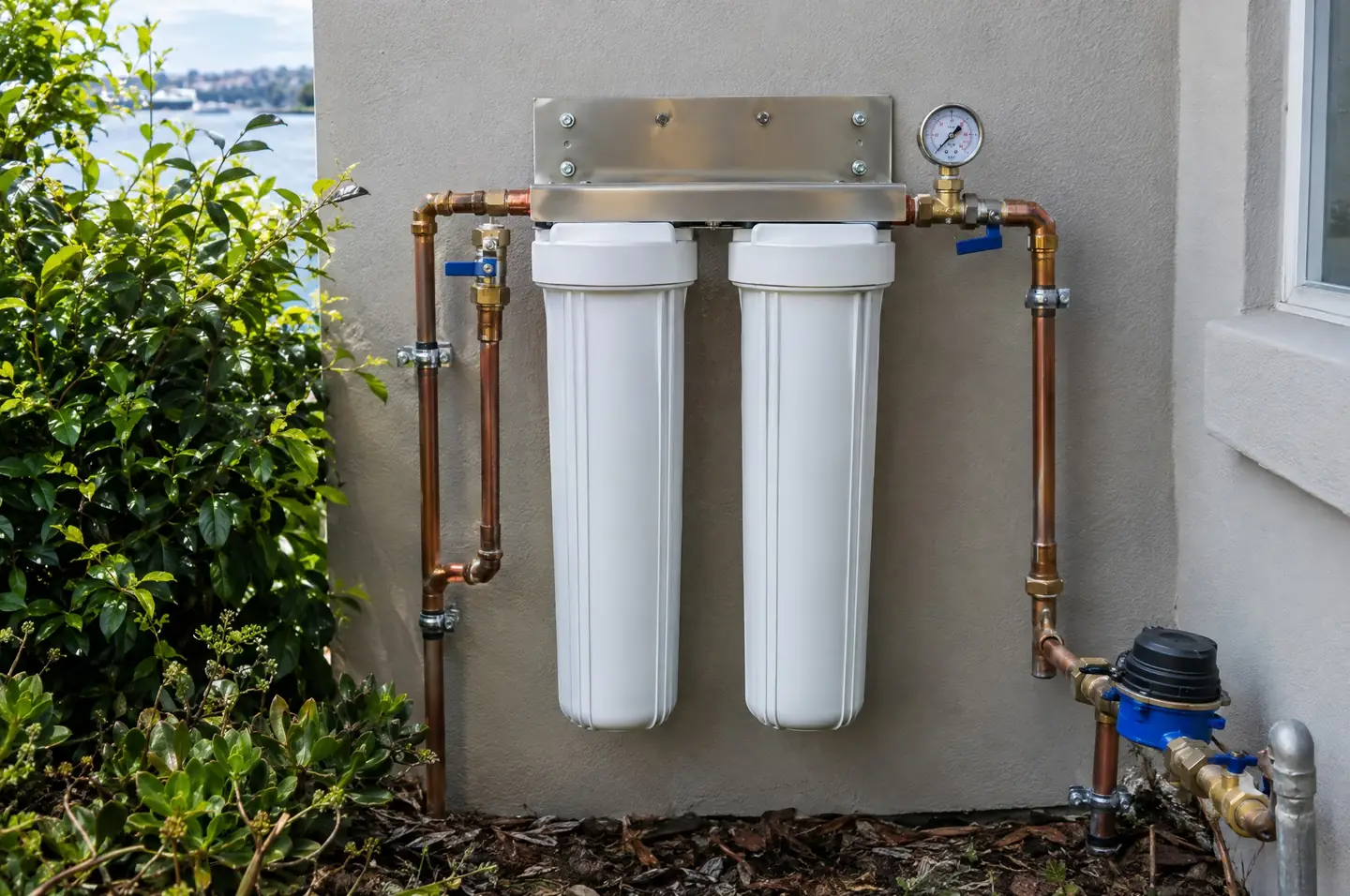
About whole-house water filters
A whole-house (point-of-entry) system treats water at the meter rather than at one tap. Most installs are two or three large housings: a sediment stage that catches grit, then carbon to reduce chlorine taste and smell. Sydney Water's supply already meets the Australian Drinking Water Guidelines, so this is a comfort decision, not a safety one. People choose it when hot showers smell of chlorine, when aerators and appliance screens keep collecting sediment from older pipes, or when they simply want one standard of water at every outlet instead of a filter under the kitchen sink.
Local conditions shape the design. Parts of Sydney's network carry chloramine, a more stable form of chlorine that ordinary carbon handles poorly; a plumber who checks Sydney Water's quarterly report for your delivery system can specify catalytic carbon where it is needed. Harbourside homes in Mosman, Vaucluse and Cremorne often have the meter on a steep front boundary, which affects where housings can go. Pre-war houses in Killara, Lindfield and Woollahra may still carry old galvanised pipework, which sheds rust whenever the street main is worked on. Apartments in Neutral Bay or Bondi can usually only be filtered at the unit's isolation valve, with owners corporation approval.
Plumbing a filter into the mains is licensed work. In NSW a licensed plumber must do it whatever the job is worth, the housings and valves must carry WaterMark certification, and the install has to comply with AS/NZS 3500, as the Plumbing Code of Australia requires. That is why we only match this job with tradies whose plumbing licence we have verified on the NSW public register, alongside their ABN, public liability insurance and recent local work. If a quote comes from someone who is not a licensed plumber, or names products without WaterMark, that is a reason to walk away.
What the job usually includes
How it works
- Tell us the jobDescribe what you want from the filter, whether it is shower chlorine, sediment or simply consistency, and send a photo of the water meter and the wall near it. Mention your number of bathrooms, whether the home is strata, and when you would like the work done.
- We match licensed local plumbersWe pass your job only to plumbers in the network who hold a current NSW plumbing licence, carry public liability insurance and have shown us recent filter installs in your area. The matching service is free for homeowners and there is no obligation to hire anyone.
- They quote you directly in writingEach plumber contacts you, asks their own questions and quotes under their own name and licence number. A good quote itemises housings, cartridges, valves and labour, names the products so you can check WaterMark, and states the cartridge change interval.
- The installationOn the day the plumber isolates the supply, mounts the housings with a bypass so water can run during future cartridge changes, fits isolation valves and a gauge, and adds a pressure-limiting valve if your mains pressure calls for one. New carbon is flushed until it runs clear and every joint is checked under pressure.
- After the jobRun the furthest tap and a shower to check pressure, confirm you have the cartridge details and interval in writing, and keep the invoice with the licence number on it. Then tell us how it went. Homeowner feedback is how tradies stay in the network or leave it.
Sizing and the right carbon separate good installs from bad
The most common complaint about whole-house filters is lost pressure, and it is almost always a sizing problem. Small housings chosen for price, or a sediment cartridge finer than the water needs, choke flow the moment two showers and a washing machine run together. A careful plumber measures incoming pressure, counts outlets and chooses large-format housings with a cartridge rating to match. They also think about where the system lives: out of direct sun if the housings are clear, with room to swing a wrench, and with a bypass so a cartridge change never means a dry house.
The second difference is the carbon. Chlorine and chloramine are separate reduction claims under NSF/ANSI 42, and a cartridge certified only for chlorine has not been tested against chloramine. Where Sydney Water's report for your delivery system shows monochloramine as the residual, catalytic carbon is the right specification. Good tradies name the cartridge and its certified claims in the quote instead of quoting percentages from packaging. They also remind you that no sediment or carbon stage removes fluoride, so if that is your aim, the honest answer is reverse osmosis at the kitchen tap, not a bigger housing at the meter.
Questions worth asking the tradie
Frequently asked questions
Yes. Sydney Water publishes quarterly quality reports for each delivery system, and the water it delivers meets the Australian guidelines for drinking water. Filtering a whole house is about taste, chlorine smell in the shower, sediment from old pipes or a preference for consistency across the house. It is not a safety fix, and a tradie who tells you otherwise is selling, not advising.
In NSW, yes. Any work on pipes connected to the water supply counts as plumbing, licensed regardless of value, and WaterMark certification is compulsory for the parts. For this job we match only plumbers whose licence we have looked up on the public register ourselves.
Every filter adds some resistance. Properly sized large-format housings keep the drop small at normal household flow. Noticeable loss usually points to undersized housings, a sediment cartridge that is too fine for the job, or one that is overdue for a change. Ask for the rated flow in the quote.
No to both. Sediment and carbon stages leave fluoride in the water, and Sydney's mains water is already soft. Sydney Water's reports typically show total hardness well under the 200 mg/L level the drinking water guidelines flag for scale, so a softener is rarely justified on mains water here. Reverse osmosis at one tap is the technology that reduces fluoride.
Sometimes. Filtering at the unit's own isolation valve is possible where there is space and the pipework is accessible, but anything touching common property or the building's risers needs the owners corporation to approve it, normally through the strata manager. Mention strata when you post the job so the plumber can plan for it.
It depends on the cartridge, how much water the house uses and how much sediment arrives. Manufacturer guides commonly put sediment and carbon cartridges at six to twelve months. A falling reading on the outlet gauge, or chlorine taste returning, means change them sooner. Ask the plumber to write the interval on the housing.